

About Us

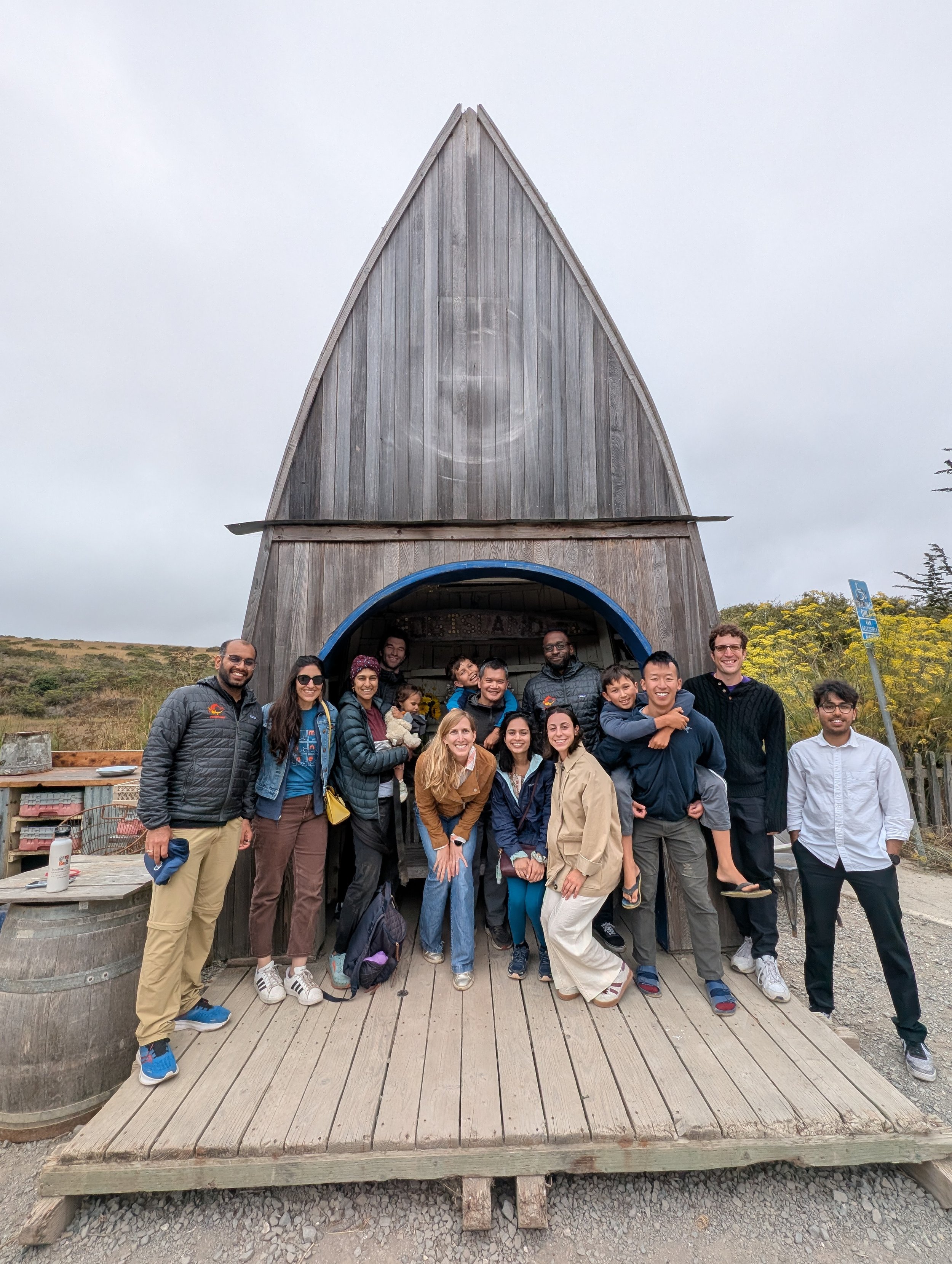
Our Story
Pumpkinseed grew out of Stanford, where nanophotonics, biochemistry, and machine learning converged around a shared conviction: that the frontiers of biology aren’t limited by wet-lab capability or even compute, but by actionable information density — how much biology you can read, per cell per dollar. That insight pointed to a gap: no existing platform was designed around that constraint. So the founding team built one.
Today, Pumpkinseed is an interdisciplinary team of physicists, biologists, engineers, chemists, and data scientists united by intellectual curiosity, a collaborative culture, and a shared belief in what direct access to the proteome makes possible. We show up every day to build the platform that reads biology directly, for the first time.
Our Vision
Biology has always held the answers. They've just been lost in translation — written in a molecular language too complex, too fleeting, and too deep to read. Pumpkinseed mines that language at its source, extracting the molecular signatures embedded in every cell, every tissue, and every organism.
Our vision: A world where the molecular signatures driving disease, aging, and ecosystem health are fully legible — where medicine shifts from reactive to proactive, and optimal healthspan, for people and for the planet, moves from aspiration to achievable reality.
The Founders

Dr. Jen Dionne — Co-Founder, Professor of Materials Science & Engineering and of Radiology at Stanford University; Chan-Zuckerberg Biohub Investigator. Jen's foundational work in nanophotonics and single-cell Raman spectroscopy is the scientific backbone of deSIPHR. Her research has been recognized with the NSF Alan T. Waterman Award, the NIH New Innovator Award, and the Presidential Early Career Award, among others.

Dr. Jack Hu — Co-Founder & CSO. PhD, Stanford. Jack's expertise in nanophotonics, bio-chemical functionalization, and biosensors drove the core engineering of the deSIPHR platform. A Stanford Biodesign and Ignite fellow and inventor on ten patents, he has translated deep photonics science into a working instrument — one amino acid at a time. Forbes 30 Under 30.

Dr. Nhat Vu — Co-Founder & CTO. PhD, UCSB. Nhat brings 15 years of experience building machine learning systems at Quantcast, Jawbone, Nest, and Google — where his teams focused on AI, computer vision, and IoT at scale. At Pumpkinseed he leads data science, bioinformatics, and the computational infrastructure that turns raw proteomic signal into biological insight.
The Team
-
Viplove Arora
Bioinformatics & AI
-
Sofia Herrero Barros
Bioinformatics & AI
-

Jacob Chamoun
Optics
-

Varun Dolia
Nanophotonics
-
Mike Elowson
Chips
-

Geoff Lovely
Biochemistry
-
Radhika Mehta
Biochemistry
-

Cooper Owen
Bioinformatics & AI
-
Andrew Serino
Biochemistry
-

Ariel Stiber
Biochemistry
-

Pranav Sundaram
System Integration
-
Vivian Wang
Nanophotonics & chips
Investors





FAQs
-
Pumpkinseed is The Biology Mining Company. We built deSIPHR — a proprietary nanophotonic chip platform — to read proteins directly, at single-molecule resolution, without prior knowledge of what's in a sample. Proteins execute nearly every function in biology, yet the tools to measure them have always been indirect, database-dependent, and incomplete. deSIPHR changes that. We are based in Palo Alto, CA and founded out of Stanford University.
-
The genomics revolution was made possible by one thing: a readable molecule. Once biology had a tool that could sequence DNA directly and at scale, the data flowed, and a rich seam of biological innovation followed.
Proteins are a different story. The proteome contains more than one million distinct proteoforms — compared to 20,000 genes in the human genome. It is the most information-rich layer of biology, and until now, the least readable. Not because the data isn't there, but because the tools to extract it haven't existed.
Existing proteomics platforms sample biology — they take limited, targeted measurements from a small, well-lit corner of the proteome. deSIPHR mines it. It reads proteins directly, without a reference catalog, at a throughput and cost trajectory that makes comprehensive biological data extraction not just possible but systematic.
-
The pumpkinseed is a small, brightly colored freshwater fish native to North America, known for the iridescent, jewel-like patterns on its scales. Pumpkinseed's nanophotonic chip wafers catch the light in much the same way as a pumpkinseed's scales: vivid, structured, and unexpectedly beautiful. It is also a nod to the idea of something small that contains the potential for something much larger.
-
Pumpkinseed was co-founded by three scientists whose disciplines don't usually share a lab and whose convergence is what made the platform possible. Prof. Jen Dionne (Stanford Engineering, Chan-Zuckerberg Biohub) whose world-leading research in nanophotonics and single-cell Raman spectroscopy is the scientific backbone of deSIPHR. Dr. Jack Hu (Forbes 30 Under 30, inventor on ten patents) translated that science into a working instrument, one amino acid at a time. Dr. Nhat Vu brings 15 years of machine learning experience from Google, Nest, and Jawbone, and leads the computational infrastructure that turns raw proteomic signal into biological insight.
-
deSIPHR stands for de novo Sequencing and Identification of Proteins with High-throughput Raman spectroscopy. It reads protein sequences the way physics reads matter — directly, from molecular vibrations. Each amino acid vibrates at a characteristic frequency; deSIPHR detects those vibrations one residue at a time using Raman spectroscopy. No reference database. No labels. No fragmentation. The result is direct, high-resolution proteomic data — including sequence, identity, post-translational modifications, and non-canonical amino acids — at a scale and fidelity that simply hasn't existed before. With over 100 billion sensors per wafer, fabricated using semiconductor manufacturing, the platform scales the way silicon scales.
-
De novo sequencing means reading a protein's sequence from first principles, without needing to know what you're looking for beforehand. Every existing proteomics platform — mass spectrometry, affinity-based methods — requires matching protein fragments against a reference database. If a protein isn't in the database, it's invisible. De novo sequencing removes that constraint entirely. It is the difference between a tool that confirms hypotheses and one that generates them, and it is why deSIPHR can find proteins that no existing method can see.
-
Mass spectrometry fragments proteins and matches the pieces against a reference database. If a protein isn't in the database, or doesn't ionize reliably, it doesn't exist as far as the instrument is concerned. deSIPHR reads protein sequences from first principles — the molecular vibrations of individual amino acids. Nothing to look up. This is not a sensitivity improvement on mass spectrometry. It is a different category of measurement entirely.
-
Rather than tagging or fragmenting proteins, Raman spectroscopy reads the molecular vibrations of individual molecules. Each amino acid vibrates at a characteristic frequency, producing a unique physical signature that deSIPHR detects directly. This is physics reading biology in the most literal sense. Pumpkinseed's proprietary VibeTag chemistry provides a greater than 1000x signal boost that makes this detection possible at single-molecule resolution and high throughput.
-
deSIPHR is a platform technology with applications wherever direct, unbiased protein measurement would change what's possible. Our current focus areas are biopharma — particularly immunopeptidomics, neuropeptide sequencing, and biologics development — biosecurity, where deSIPHR can detect engineered protein threats that no database-dependent method can see, and biological AI, where we generate the single-cell proteomic datasets that the next generation of virtual cell models and foundation models require.
-
Genentech's Discovery Proteomics group is an active biopharma partner, where our work in immunopeptidomics is already revealing peptide targets that mass spectrometry cannot detect. We hold active contracts with DARPA and BARDA across defense and biosecurity applications, and have a manufacturing and fabrication relationship with IMEC. Pumpkinseed has secured over $12 million in committed near-term revenue across these partnerships.
-
We are actively partnering with teams where direct protein measurement would change what's possible in their programs. That includes immunopeptidomics programs in cancer vaccine development, autoimmune research, and biologics immunogenicity; process analytic teams monitoring biologic drug manufacturing; and synthetic biology groups engineering cells as biological factories, where the protein output of engineered cell lines is complex, novel, and poorly characterized by existing methods. If you are working on a protein problem that existing methods cannot fully address, we would like to talk.
-
We work with partners on defined sequencing programs. Partners bring samples, biological questions, and domain expertise; our team contributes the platform, experimental design, and the analytical infrastructure to translate proteomic findings into actionable insights. Early partnerships are structured as pilots, with the opportunity to deepen into broader data-sharing and co-development arrangements as the platform scales.
-
We are headquartered in Palo Alto, CA. Our team of physicists, biologists, engineers, chemists, and data scientists is growing. For current opportunities, contact us at info@pumpkinseed.bio.