
AI is beginning to transform biology. But a constraint is blocking our progress.
AI can only learn the biology we can measure.
Today, we can read and write DNA at an extraordinary scale. We can measure RNA across millions of cells. We can image tissues in remarkable detail. But we still cannot comprehensively read the molecules that carry out much of biology's work: proteins.
Proteins are where genetic information becomes biological function. They catalyze reactions, transmit signals, recognize threats, build cells, and determine how those cells respond to drugs and disease.
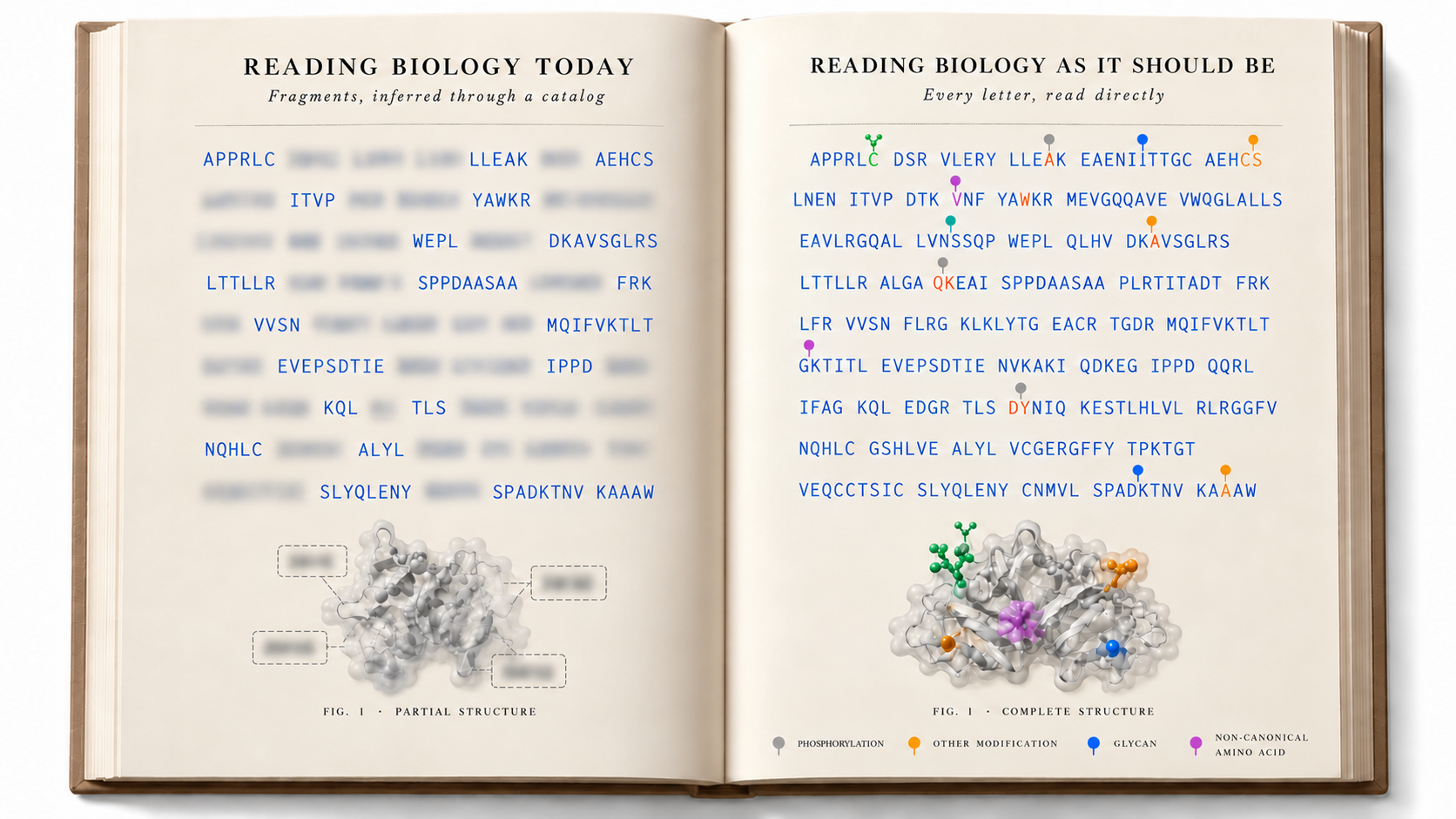
Their molecular language extends far beyond the four-letter genetic code. It’s a complex language of its own: 20 canonical amino acids and thousands of possible post-translational modifications, plus mutations, non-canonical amino acids, processing events, and molecular interactions that can transform what a protein does.
Yet much of this language remains difficult to read at scale. That measurement gap is becoming a fundamental constraint on BioAI. To build AI that can truly understand and predict biology, we need to make its functional molecular layer readable.
At Pumpkinseed, we’re building the technology to make that possible.
Why BioAI Needs the Protein Data Layer
Advances in algorithms, computing power, and enormous datasets have driven extraordinary progress in AI. But as models grow more powerful, access to high-quality data is becoming a critical bottleneck.
Biology faces an even more fundamental challenge: much of the data we need doesn't exist yet.
DNA encodes possibility. RNA reveals which instructions a cell is using. Proteins put those instructions into action.
To move from using AI to recognize biological patterns toward predicting—and ultimately shaping—biological outcomes, we need to understand what molecules are actually doing.
Dynamic, protein-level measurements provide a more direct view of cellular function, revealing the molecular machinery behind signaling, metabolism, immune responses, and drug activity. They bring us closer to phenotype: what cells and biological systems actually do.
But the opportunity isn't simply to generate more protein data. It's to generate richer, and more connected data.
We believe the most valuable biological datasets won't simply be the largest. They will combine breadth with depth, preserving the molecular detail models need to learn. By connecting molecular identity to interactions, interactions to functional states, and functional states to biological outcomes, we can begin to reveal relationships that today's measurements often miss.
The opportunity ahead is to create a new experimental data layer that connects what biological molecules are to what they do.
That's why we're building Pumpkinseed.
Read. Connect. Predict.
Our goal is to make biology's functional molecular layer readable at a scale and resolution never before possible.
We began with one question: how do we maximize the information gleaned per sample, per dollar, and deliver it fast enough to drive decision-making?
Our answer is deSIPHR™ – our high-throughput Raman platform for reading protein biology. deSIPHR combines nanophotonics, biochemistry, semiconductors, and machine learning to measure biology across multiple dimensions, from molecular identity and sequence to functional state.
At its foundation is a semiconductor-scalable nanophotonic architecture designed for massively parallel molecular measurements, with approximately 100 billion light-concentrating sensors per wafer. Combined with our advances in vibrational reporters and iterative chemistry, this architecture offers a path to directly read protein sequences, one amino acid at a time.
Rather than relying exclusively on reference catalogs to identify proteins we already know to look for, our vision is to read the molecular information physically present in a sample—including sequences and chemical modifications that conventional approaches may overlook.
But identity is only the beginning.
Reading a protein's sequence tells us what it is. Understanding its interactions, structural changes, and functional states helps reveal what it does. The same massively parallel nanophotonic platform offers a path to connect molecular identity with interactions, cellular responses, and ultimately biological outcomes.
By generating direct, high-dimensional protein measurements at semiconductor scale, we aim to build rich, interconnected datasets that link molecular structure to function. These datasets could transform how we discover drug targets, map protein–drug interactions, identify the antigens tumors present, and understand why therapies succeed or fail.
The opportunity is bigger than a new measurement platform. It's the foundation for a new generation of biological insight—one that lets us move from identifying molecules to understanding their behavior and predicting their effects.
We’re the Biology Mining Company
The Human Genome Project helped launch an era in which DNA became readable at scale. The technologies and infrastructure that followed transformed biology and created entire industries that were difficult to imagine when the project began.
We believe proteins are the next great frontier in biological measurement.
The next great biological dataset—the one that captures the molecular complexity underlying life's functions—doesn't exist at the scale or depth we need today.
It won't simply be scraped from the internet. It will have to be measured.
That's why we call ourselves the Biology Mining Company. We're building the tools to uncover biology's hidden molecular data layer and turn previously inaccessible information into understanding.
Our ambition is simple: to make biology readable, connect identity to function, and ultimately predict how living systems behave.
Join us.
