
Pumpkinseed Shines New Light on the Proteome
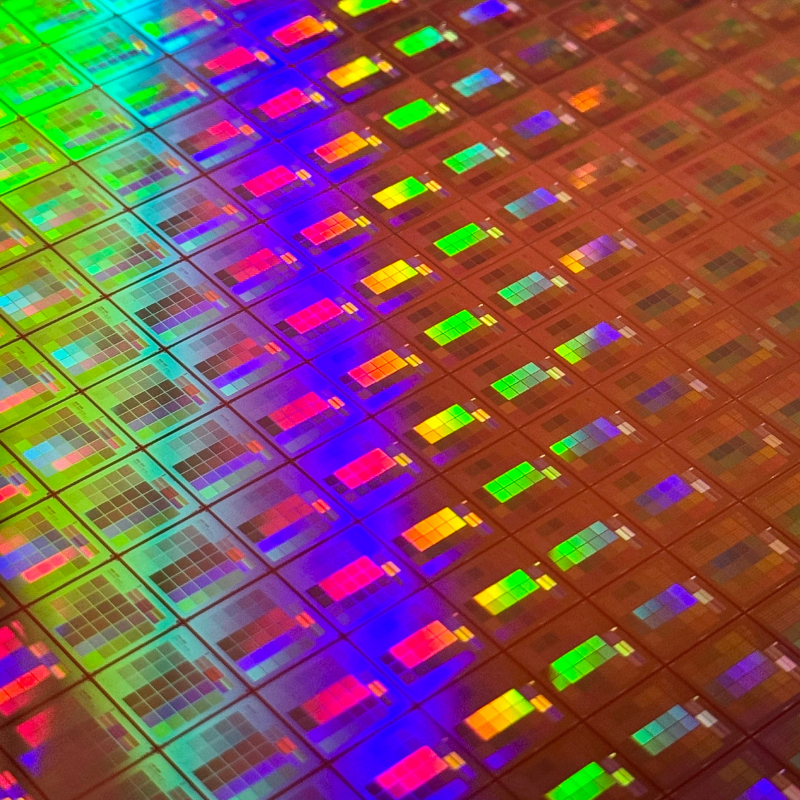
Pumpkinseed's proprietary deSIPHR nanophotonic chip, fabricated using standard semiconductor manufacturing processes. With over 100 billion sensors per square centimeter, deSIPHR reads proteins letter by letter — amino acid by amino acid — without a reference catalog.
Pumpkinseed Wants to Sequence Every Protein in Every Cell. Its Nanophotonic Chips May Finally Make That Possible
by Mohamed Soufi Apr 24, 2026
In an exclusive conversation ahead of their appearance at SynBioBeta 2026 on May 4-7th in San Jose, Pumpkinseed co-founder and Stanford Professor Jennifer Dionne outlined a vision to open up the proteome for investigation in a way the field has never had before. Whole-genome sequencing now costs less than a hundred dollars. Transcriptomic atlases map gene expression across millions of single cells. And yet the equivalent tools for proteins, the molecules that actually execute every cellular decision, remain largely invisible at that scale. Dionne and her co-founders, Dr. Jack Hu and Dr. Nhat Vu, built Pumpkinseed to close that gap.
"We are a biology mining company, extracting the molecular intelligence embedded in every cell and tissue, at a resolution and scale the field has never had before," Dionne says.
Proteomics is harder than most people outside the field appreciate. When you account for post-translational modifications, non-canonical amino acids, and glycan decorations, there are roughly a thousand distinct chemical monomers in the proteomic alphabet, compared to the four bases of DNA. And unlike DNA, protein’s function comes from its structure rather than raw sequence. Existing tools, chiefly mass spectrometry and Edman degradation, are slow, require prior knowledge of what they are looking for, and miss any novel modifications or non-canonical amino acids. If a molecule is not in the catalog, it is invisible.
Raman spectroscopy offers a way around that problem. Every chemical bond scatters light at a characteristic frequency, producing a molecular fingerprint as specific as a barcode. The historical obstacle has been sensitivity. With conventional Raman spectroscopy, only about one in ten million photons interacts with a molecule usefully, far too weak for single-molecule work.
Pumpkinseed's answer is a silicon photonic chip patterned with 100 million sensors per square centimeter. Those sensors concentrate light into volumes smaller than a single protein, amplifying Raman scattering efficiency by over 10 million-fold. The chips are manufactured using standard semiconductor fabrication processes, meaning the platform inherits the same scalability as the computer chip industry and requires no exotic infrastructure to deploy. Backed by DARPA's PROSE program, the company is targeting full-length proteins of three hundred or more residues by 2028.
"Pumpkinseed reads directly from molecular vibrations, requiring no catalog and no prior knowledge of what it is looking for," Dionne says. "That is a different category of capability, not an incremental improvement."
The founding conviction came from a Genentech collaboration in which the team needed to distinguish MHC class I immunopeptides differing by a single amino acid, sequences so similar that mass spectrometry cannot reliably tell them apart. Pumpkinseed could. Reading directly from vibrational signatures, with no fragmentation step and no reference catalog, the platform resolved the two peptides at single-residue resolution. To anticipate signatures for modifications and residues not yet encountered experimentally, the team built a computational pipeline that predicts Raman spectra from first principles. Together, those two capabilities pointed toward something bigger.
"A single misread residue is the difference between durable immunity and a therapy that fails before it starts," Dionne says. "That moment opened a bigger question: if we can mine biological information this richly from known peptides, could we read the sequences of proteins whose identity we don't know in advance?"
Getting there required building a company, which carried its own friction. Stanford's translation culture and investor access were genuine advantages. But incorporating means leaving campus, and standing up an independent nanophotonics lab before commercial proof exists is a funding gap that hits hardware founders far harder than software.
"You need funding to stand up an independent lab before you've proven anything commercially," Dionne says. "For a company building nanophotonic chips and sequencing instruments, that's a significant early hurdle." Closing that gap, she argues, would unlock a generation of deep tech companies that currently stall at exactly that stage.
The longer-term ambition is the virtual cell, a computational model that simulates not just how proteins fold but how they interact, respond to drugs, and behave under perturbation inside a living system. AlphaFold demonstrated what structural AI can do once a sequence is known. The gap that cannot be closed is determining the sequence itself from biological samples, particularly for proteins carrying modifications absent from existing databases. Pumpkinseed is designed to supply that input layer.
"The proteome, with its modifications, isoforms, and non-canonical amino acids, is where biology is actually executed, and no existing platform generates that data at the resolution and scale that virtual cell models require," Dionne says. "Pumpkinseed is uniquely positioned to change that."
The company takes its name from the most colorful freshwater fish in North America. The shimmer of the platform's protein-detecting chips mirrors the iridescent scales of Lepomis gibbosus, a small detail that reflects how Dionne thinks about the work, technically precise and pointed toward something larger than any single application.
"If the Human Genome Project was the data infrastructure that enabled genomic medicine, we believe the high-resolution proteomic dataset Pumpkinseed is building could be the analogous foundation for AI-driven biological discovery," Dionne says. "In our vision, the molecular signatures driving disease, aging, and ecosystem health become fully legible. Medicine shifts from reactive to proactive. Optimal healthspan moves from aspiration to achievable reality."
