
DynaSpec: Metadynamics and Raman Spectroscopy for Glycan Structure–Spectrum Mapping
Varun Dolia, Nicholas Siemons, Jack Hu, Jennifer Dionne, DynaSpec: Metadynamics and Raman Spectroscopy for Glycan Structure–Spectrum Mapping, ChemRxiv (2026)
Abstract:
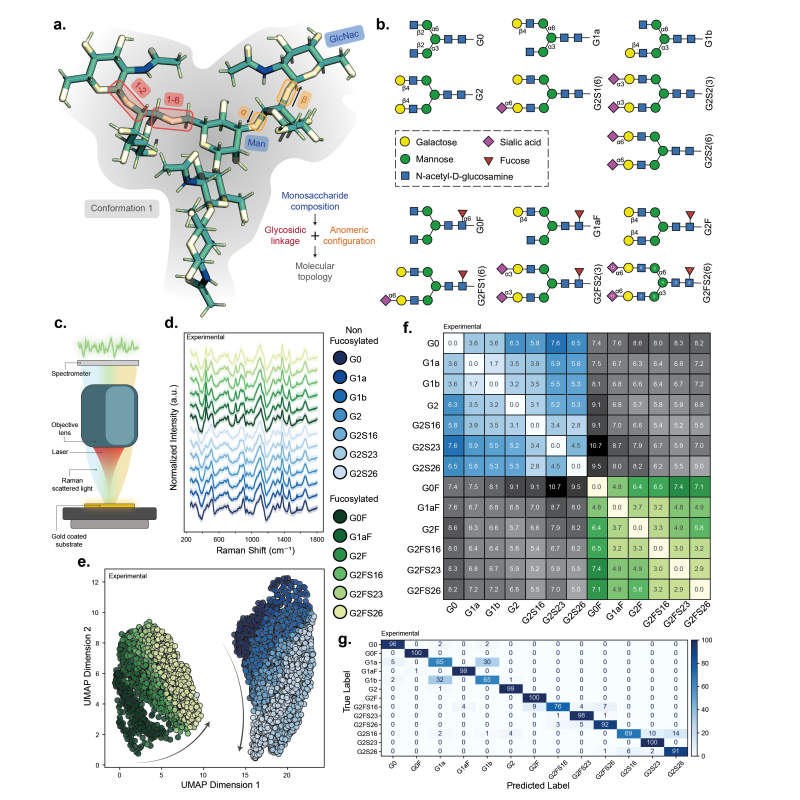
Raman spectroscopy offers label-free access to molecular vibrations across biological systems of varying complexities, from small molecules to flexible biomolecular oligomers and even whole cells. While Raman spectra of small molecules often permit direct structural interpretation, intermediate-sized systems—such as glycans, short nucleic acids, and peptides—exhibit higher compositional and conformational heterogeneity that obscures structure–spectrum relationships. We introduce DynaSpec, a framework integrating metadynamics performed in a machine-learned latent space with population-weighted DFT Raman calculations and experimental Raman spectroscopy to enable quantitative, bidirectional mapping between molecular structure and vibrational spectra. By determining equilibrium conformational populations and linking normal modes to the structural coordinates that modulate them, DynaSpec enables mechanistic interpretation of congested Raman profiles. Applied to glycans, DynaSpec’s ensemble-averaged DFT predictions agree with experimentally acquired spectra that support >85% classification accuracy across 13 N-glycans. Metadynamics reveals a conserved α6 open–curled switching motif, and the combined analysis identifies a glycosidic torsion-enriched window that enables experimental positional isomer discrimination to >70% accuracy. DynaSpec also generalizes to O-glycans and sulfated glycosaminoglycans. Together, these capabilities establish an ensemble-resolved framework for structure-informed spectroscopy for different classes of biomolecules.
